

Semaphore 字面意思是信号量的意思,它的作用是控制访问特定资源的线程数目。
1.应用示例
场景:资源访问,服务限流
public class SemaphoreDemo {

    public static void main(String[] args) {
    	// 限流,同一时刻最多能有两个线程执行
        Semaphore semaphore = new Semaphore(2);
        for (int i = 0; i < 5; i ++) {
            new Thread(new Task(semaphore, "zhangsan +" + i)).start();
        }
    }

    static class Task extends Thread {
        Semaphore semaphore;
        public Task(Semaphore semaphore, String threadname) {
            this.semaphore = semaphore;
            this.setName(threadname);
        }

        public void run() {
            try {
            	// 申请资源(同时最多两个thread)
                semaphore.acquire();
                System.out.println(Thread.currentThread().getName() + ": acquire() at time:" + System.currentTimeMillis());
                Thread.sleep(1000);
                // 释放资源
                semaphore.release();
                System.out.println(Thread.currentThread().getName() + ": release() at time:" + System.currentTimeMillis());
            } catch (InterruptedException e) {
                e.printStackTrace();
            }

        }
    }

}
结果如下:
Thread-3: acquire() at time:1618487257823
Thread-1: acquire() at time:1618487257823
Thread-3: release() at time:1618487258824
Thread-5: acquire() at time:1618487258824
Thread-1: release() at time:1618487258824
Thread-9: acquire() at time:1618487258824
Thread-7: acquire() at time:1618487259825
Thread-9: release() at time:1618487259825
Thread-5: release() at time:1618487259825
Thread-7: release() at time:1618487260825
可以看到两点
- 同一时刻最多只能有两个线程同时执行
- 只有一个线程 release() 后,才能有一个新线程 acquire()
2.源码分析
Semaphore 的源码实现其实跟 CountDownLatch 很相似,都是通过直接复用 AQS 来实现的(内部类 Sync);
PS:关于 CountDownLatch 的使用示例及源码分析,请看这篇文章…
我们先来看看 Semaphore 的构造函数做了什么
public Semaphore(int permits) {
    sync = new NonfairSync(permits);
}
Semaphore 的构造函数实际上是构造了一个 NonfairSync(非公平锁),并传入了我们预设的最大允许执行线程数
可以看到,NonfairSync 实际上是调用了 AQS 的构造函数,是将 AQS 的 state 从默认的 1 改成了我们预设的 permits。这也正是 Semaphore 能同时多个线程执行的关键所在。
2.1 acquire()
当使用 Semaphore 后,要申请资源时调用 acquire() 方法
public void acquire() throws InterruptedException {
    sync.acquireSharedInterruptibly(1);
}
再来看 acquireSharedInterruptibly() 方法,该方法是在 AQS 中的,Semaphore 的内部类 Sync 并没有自己实现/重写:
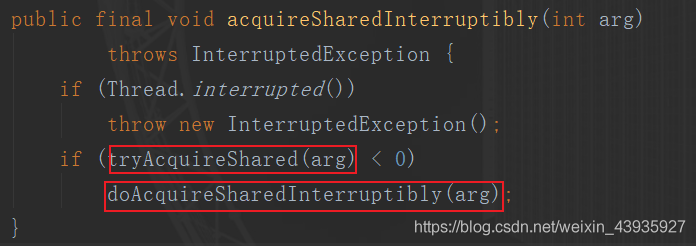
这里有两个核心方法,tryAcquireShared() 和 doAcquireInterruptibly(),它俩的关系是,当 tryAcquireShared() 判断无法拿到锁时,就会进入 AQS 的 doAcquireInterruptibly() 方法。
tryAcquireShared()
这个方法最终会走到内部类 Sync 的 nonfairTryAcquireShared() 方法
// Semaphore.Sync
final int nonfairTryAcquireShared(int acquires) {
	// 自旋
    for (;;) {
        int available = getState();
        // 计算修改后的 AQS 的 state(减去当前线程要申请的资源数)
        int remaining = available - acquires;
        //  当修改后的 state 大于 0,且 CAS 能够修改成功时,可以拿锁
        if (remaining < 0 ||
            compareAndSetState(available, remaining))
            return remaining;
    }
}
doAcquireSharedInterruptibly()
// AQS
private void doAcquireSharedInterruptibly(int arg)
        throws InterruptedException {
    	// 将当前线程封装为node(共享模式),并加到同步队列队尾
        final Node node = addWaiter(Node.SHARED);
        boolean failed = true;
        try {
        	// 自旋,保证所有被唤醒的线程都能依次恢复运行
            for (;;) {
                final Node p = node.predecessor();
                // 当前node前进到队二 && tryAcquire成功(state减到0),就可以执行了
                if (p == head) {
                	// 判断是否能拿到锁
                    int r = tryAcquireShared(arg);
                    if (r >= 0) {
                    	// setHeadAndPropagate 会调用 doReleaseShared 去唤醒后续 Shared 节点
                        setHeadAndPropagate(node, r);
                        p.next = null; // help GC
                        failed = false;
                        return;
                    }
                }
                // 其余线程阻塞(最后也是在此处醒来)
                if (shouldParkAfterFailedAcquire(p, node) &&
                    parkAndCheckInterrupt())
                    throw new InterruptedException();
            }
        } finally {
            if (failed)
                cancelAcquire(node);
        }
}
注:虽然是共享锁模式,一个线程拿锁之后会唤醒同步队列中后续的 Shared 节点,但醒了后还要判断是否能拿到锁(tryAcquireShared),所以还会再次陷入休眠。(其实我觉得这里或许可以用互斥锁模式,欢迎讨论。。。)
2.2 release()
当使用 Semaphore,某个线程要释放资源时,调用 release()
public void release() {
    sync.releaseShared(1);
}
releaseShared()
// AQS
public final boolean releaseShared(int arg) {
	// 判断能否释放锁(修改state)
    if (tryReleaseShared(arg)) {
    	// 唤醒后续线程
        doReleaseShared();
        return true;
    }
    return false;
}
tryReleaseShared()
// Semaphore.Sync
protected final boolean tryReleaseShared(int releases) {
	// 自旋,保证 state 修改一定能成功
    for (;;) {
        int current = getState();
        // 将 state 加上当前线程锁持有的资源数
        int next = current + releases;
        if (next < current) // overflow
            throw new Error("Maximum permit count exceeded");
        // CAS 修改 state
        if (compareAndSetState(current, next))
            return true;
    }
}
doReleaseShared()
// AQS
private void doReleaseShared() {
    // 自旋,保证所有线程正常的线程都能被唤醒
    for (;;) {
        Node h = head;
        // 还没有到队尾,此时队列中至少有两个节点
        if (h != null && h != tail) {
            int ws = h.waitStatus;
            // 如果头结点状态是 SIGNAL ,说明后续节点都需要唤醒
            if (ws == Node.SIGNAL) {
                // CAS 保证只有一个节点可以运行唤醒的操作
                if (!compareAndSetWaitStatus(h, Node.SIGNAL, 0))
                    continue;            // loop to recheck cases
                // 进行唤醒操作
                unparkSuccessor(h);
            }
            else if (ws == 0 &&
                     !compareAndSetWaitStatus(h, 0, Node.PROPAGATE))
                continue;                // loop on failed CAS
        }
        // 退出自旋条件 h==head,一般出现于以下两种情况
        // 第一种情况,头节点没有发生移动,结束。
        // 第二种情况,因为此方法可以被两处调用,一次是获得锁的地方,一处是释放锁的地方,
        // 加上共享锁的特性就是可以多个线程获得锁,也可以释放锁,这就导致头节点可能会发生变化,
        // 如果头节点发生了变化,就继续循环,一直循环到头节点不变化时,结束循环。
        if (h == head)                   // loop if head changed
            break;
    }
}

还没有评论,来说两句吧...